Santorini
A Story Written in Fire, Ash & Salt
There are places in the world that feel as though they were shaped gently, carved by rivers and softened by time. Then there’s Santorini. It’s a place born in violence, sculpted by fire, and softened only by the quiet persistence of human life returning again, and again.
The island does not simply exist. It remembers.
Before the Ash Fell
Before the sky darkened, Santorini was whole. It was a single island, a thriving trade hub, and a place where ships came and went, carrying stories between Crete, Egypt, and beyond.
Akrotiri stood at its heart—alive with movement, color, and commerce. Frescoes adorned everything, pottery lined shelves, and tools spoke of skilled hands and steady lives. It was not a fragile place, but even the strongest things can be undone by what sleeps beneath them.
The Day the World Broke Open
Around 1500 BCE, Santorini was a single round island known as Strongili, or “round one” and was home to a thriving Bronze Age civilization. Influenced by the Minoans of Crete, it pulsed with trade, artistry, and life.
Then the earth split.
The Minoan Volcanic Eruption was one of the most catastrophic in human history. An estimated 100 billion cubic feet of lava, ash, and rock tore into the sky, rivaling modern eruptions like the Hunga Tonga-Hunga Ha’apai in 2022. The island shattered, collapsing inward and forming the dramatic caldera we see today.
What remained were fragments: Thira, Thirassia, Aspronissi, Palea Kameni, and Nea Kameni; the last two still whispering with volcanic breath that last stirred in 1950.
Ash fell thick, up to 60 meters (196ft) deep and blanketed everything. Near Akrotiri, a city preserved beneath ash, archaeologists uncovered frescoes (watercolor painted onto wet plaster to set the paintings), pottery, and multi-story homes— evidence of a sophisticated, vibrant society. But no human remains, which suggests something almost hauntingly hopeful: they saw it coming, and they ran.
Even so, the eruption is believed to have marked the beginning of the decline of the Minoan civilization.
Empires Rise, Empires Leave
Centuries passed. The island changed hands, changed names, changed faiths.
From 1st century BCE to the 13th century BCE, Santorini became part of the Roman Empire, later transitioning into the Byzantine Empire. Roads expanded, public buildings rose, and churches and monasteries took root. Basilicas spread Orthodox Christianity across the island.
Then came the whispers of danger—pirate threats cutting across the Aegean.
In 1204, after the Fourth Crusade, an armed expedition to reclaim the city of Jerusalem, Santorini fell under Venetian rule. It was during this time that the island received its modern name, inspired by Saint Irene, otherwise known as the Great Martyr for enduring torture without renouncing her faith.
Under Venetian hands, Santorini flourished once more, this time through wine production and maritime trade. Fortresses rose along the cliffs: Pyrgos Kastelli, Skaros Castle, and Oia Castle—stone sentinels against the sea and those who came with ill intent.
From 1579 to 1830, Santorini lived beneath the weight of the Ottoman Empire, the largest political entity in Europe and Western Asia. Even under foreign rule, life continued. The wine industry prospered, rooted deep in volcanic soil that had once brought destruction.
Then, like so many places shaped by history, Santorini found itself drawn into a revolution. During the Greek War for Independence between 1821 and 1830, the island joined the fight, and in 1830, it became part of the modern Greek state.
What Remains, What Endures
Since then, Santorini has become something softer, but no less resilient. It thrives in sea trade, in wine, in sun-ripened tomatoes, in pumice stone shaped by its own violent past. Textiles, wool, and linen pass through hands that carry generations of memory.
It has endured earthquakes.
It has endured time.
And now, it welcomes the world.
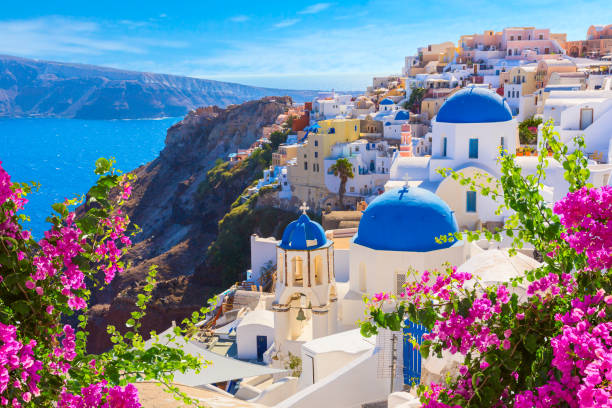
As a tourist destination, yes. But beneath the white walls and blue domes, beneath the golden sunsets and quiet cafes, there is something older. Something that remembers fire.